Executive Summary
Human civilization has long advanced through the accumulation of knowledge and the development of skills. This knowledge-centric paradigm has transformed education, medicine, technology and society.
Yet one fundamental question remains largely overlooked:
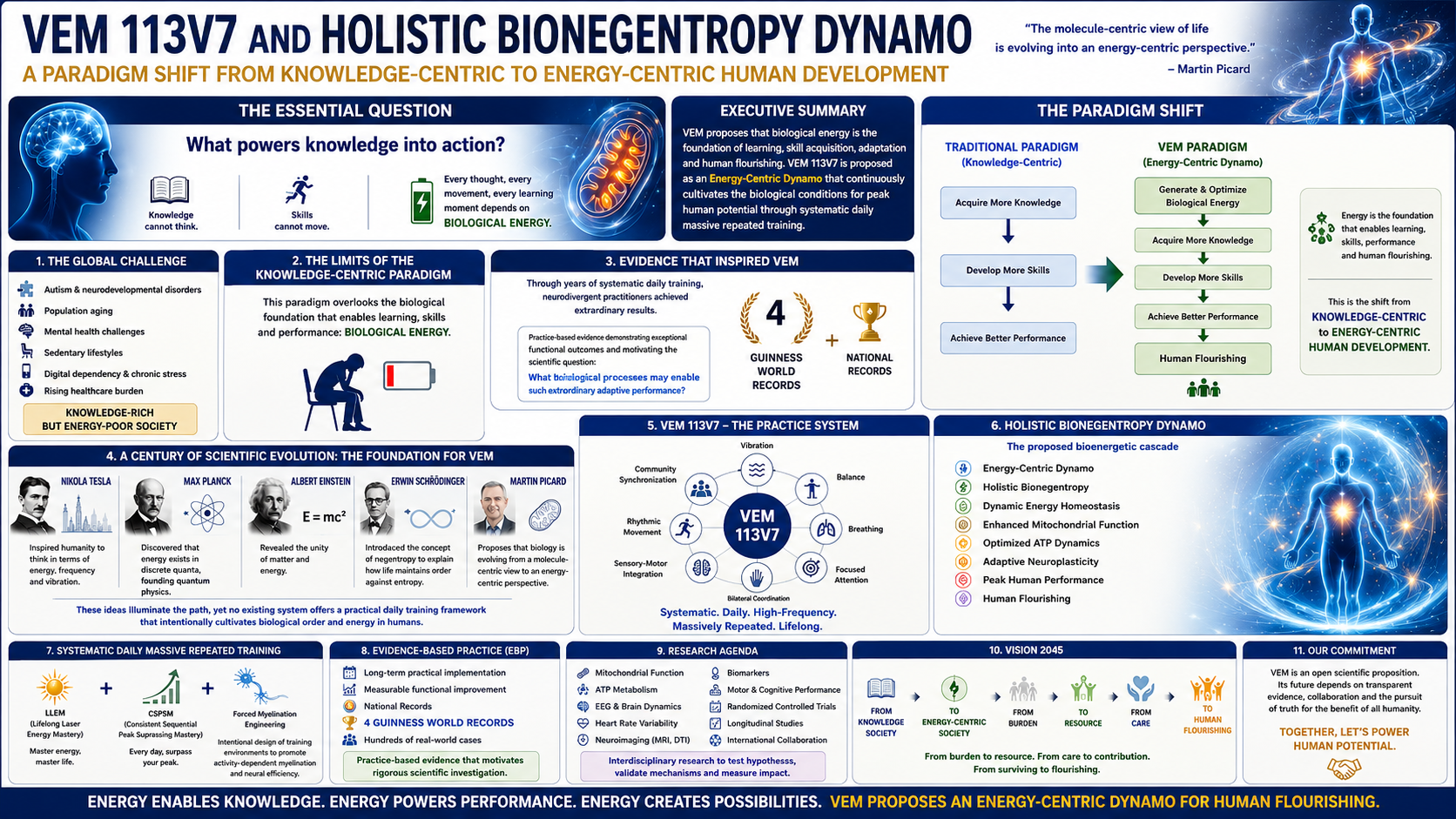
What powers knowledge into action?
Knowledge alone cannot think.
Skills alone cannot move.
Every cognitive process, emotional response, motor action and adaptive behavior ultimately depends upon biological energy.
Inspired by the emerging field of energy-centric biology and motivated by years of evidence-based practice (EBP), VEM proposes a new conceptual framework:
Energy-Centric Human Development.
Rather than viewing biological energy as a consequence of learning and performance, VEM proposes that biological energy should become the primary target of systematic human training.
At the center of this framework is VEM 113V7, proposed as an Energy-Centric Dynamo capable of continuously cultivating the biological conditions that support learning, adaptation, resilience and human flourishing.
This white paper presents a conceptual hypothesis intended for rigorous interdisciplinary evaluation rather than a claim of established scientific fact.
1. The Global Challenge
The twenty-first century faces unprecedented human challenges.
Autism spectrum disorder.
Population aging.
Mental health disorders.
Sedentary lifestyles.
Digital dependency.
Chronic stress.
Despite unprecedented access to knowledge, many societies are experiencing declining physical resilience, reduced attention, increasing developmental disorders and growing healthcare burdens.
Modern civilization has become increasingly knowledge-rich, yet often energy-poor.
This raises an important question:
Can optimizing biological energy become a new frontier for human development?
2. The Limits of the Knowledge-Centric Paradigm
For generations, human development has largely followed a familiar sequence:
Acquire More Knowledge
↓
Develop More Skills
↓
Achieve Better Performance
This paradigm has produced extraordinary progress.
However, it rarely asks what enables knowledge acquisition, skill execution and sustained performance at the biological level.
Knowledge does not generate ATP.
Skills do not power neurons.
Every learning process depends upon living cells supplied with energy.
Knowledge and skills therefore rest upon a deeper biological foundation.
3. Evidence That Inspired VEM
The VEM framework did not originate from laboratory theory.
It emerged from long-term practical work with neurodivergent individuals.
Over years of systematic daily training, the VEM ecosystem documented remarkable functional improvements, culminating in four Guinness World Records achieved by neurodivergent practitioners.
These achievements are presented as practice-based evidence.
They demonstrate exceptional real-world outcomes.
They do not, by themselves, establish the biological mechanisms proposed in this paper.
Instead, they motivate an important scientific question:
What biological processes might enable such extraordinary adaptive performance following long-term systematic practice?
This question became the starting point of VEM.
4. A Century of Scientific Evolution
VEM is inspired by a sequence of scientific ideas developed over more than a century.
Nikola Tesla
Tesla encouraged humanity to think in terms of energy, frequency and vibration, inspiring generations of interdisciplinary exploration.
Max Planck
Planck established that energy exists in discrete quanta, laying the foundation of modern quantum physics.
Albert Einstein
Einstein demonstrated the unity of matter and energy through:
E = mc²
placing energy at the center of physical reality.
Erwin Schrödinger
In What Is Life? (1944), Schrödinger introduced the concept of negative entropy (negentropy) to explain how living systems maintain order against entropy.
He established a profound theoretical principle but did not propose a practical methodology for intentionally cultivating biological order through training.
Martin Picard
Contemporary mitochondrial biology has further shifted scientific thinking.
Martin Picard has argued that biology is evolving from a molecule-centric view of life toward an energy-centric perspective.
His work emphasizes mitochondria as dynamic regulators of energy transformation, signaling, adaptation and resilience rather than merely cellular powerhouses.
Together, these scientific developments provide an intellectual context for VEM's conceptual framework.
5. The Paradigm Shift
Building upon these developments, VEM proposes a new conceptual model.
Traditional Paradigm
Acquire More Knowledge
↓
Develop More Skills
↓
Achieve Better Performance
VEM Paradigm
Generate and Optimize Biological Energy
↓
Acquire More Knowledge
↓
Develop More Skills
↓
Achieve Better Performance
↓
Human Flourishing
This represents the proposed transition:
From Knowledge-Centric Development
to
Energy-Centric Human Development.
6. VEM 113V7
VEM (Vibrating Energy Mastery) is proposed as a systematic practice framework integrating:
-
vibration,
-
balance,
-
breathing,
-
focused attention,
-
bilateral coordination,
-
sensory-motor integration,
-
rhythmic movement,
-
community synchronization,
-
systematic daily, high-frequency, deliberately repeated training.
The underlying premise is that sustained practice may strengthen the biological conditions that support adaptive performance.
7. Holistic Bionegentropy Dynamo
Within the VEM framework, Holistic Bionegentropy Dynamo is proposed as a conceptual model describing a continuously operating training system that promotes adaptive biological organization.
The term Dynamo emphasizes continuous generation rather than static capacity.
The proposed cascade is:
VEM 113V7
↓
Energy-Centric Dynamo
↓
Holistic Bionegentropy
↓
Dynamic Energy Homeostasis
↓
Enhanced Mitochondrial Function
↓
Optimized ATP Dynamics
↓
Adaptive Neuroplasticity
↓
Peak Human Performance
↓
Human Flourishing
This cascade represents a research hypothesis rather than an established biological pathway.
8. Systematic Daily Massive Repeated Training
A defining characteristic of VEM is its emphasis on systematic, daily, massively repeated training.
Rather than relying on occasional intensive interventions, VEM proposes that biological adaptation emerges through consistent, long-term repetition.
This principle is operationalized through:
-
Lifelong Laser Energy Mastery (LLEM),
-
Consistent Sequential Peak Surpassing Mastery (CSPSM),
-
progressively increasing challenge,
-
continuous practice,
-
community reinforcement,
-
measurable functional outcomes.
Within this framework, adaptive neural remodeling is viewed as an activity-dependent process supported by repeated practice rather than passive recovery.
9. Evidence-Based Practice
VEM adopts an Evidence-Based Practice (EBP) approach.
The current evidence includes:
-
long-term practical implementation,
-
measurable functional improvement,
-
national records,
-
four Guinness World Records, and
-
extensive observational experience with neurodivergent participants.
These outcomes are presented as practice-based evidence.
Future validation should combine these observations with objective biological measurements, including:
10. Research Agenda
The next stage of VEM requires international interdisciplinary collaboration.
Priority research directions include:
-
mitochondrial bioenergetics,
-
ATP dynamics,
-
adaptive neuroplasticity,
-
motor learning,
-
rehabilitation science,
-
developmental neuroscience,
-
human performance science,
-
randomized controlled trials,
-
longitudinal cohort studies,
-
biomarker validation.
The purpose is not to confirm VEM prematurely but to evaluate its hypotheses through rigorous scientific investigation.
11. Vision
The twentieth century optimized knowledge.
The early twenty-first century optimized skills.
VEM proposes that the next frontier is optimizing biological energy.
Its long-term vision is a society in which human development begins not only with knowledge acquisition but also with cultivating the biological capacity that enables learning, resilience, creativity and flourishing.
Ultimately, VEM proposes a shift:
From Knowledge-Centric Development
↓
To Energy-Centric Human Development
↓
Toward Human Flourishing
This vision remains an open scientific proposition.
Its future depends not on belief, but on transparent evidence, interdisciplinary collaboration and continuous empirical validation.