I. Abstract
Traditional mindfulness models face a critical "translation crisis," where subjective internal calm achieved in static environments fails to persist under high-velocity external stress. This paper introduces Dynamic Mindfulness Coherence (DMC), a novel developmental paradigm shifting focus from unmeasurable "black box" states to objective, physics-based mastery. We posit that Dynamic Balance (Cân bằng động) is the most stable form of balance, as it utilizes movement to generate structural resilience. Through Quantum Resonant Vibrating Energy Mastery (QRVEM) and the 3-Pillar Alignment (Tam Tài), we demonstrate how high-complexity tasks (VEM) myelinate Neural Superhighways (SLLEM). This results in an unshakeable system capable of maintaining a laser-like signal in the eye of any storm, offering a breakthrough intervention for both high-performance leadership and neurodivergent conditions such as Autism.
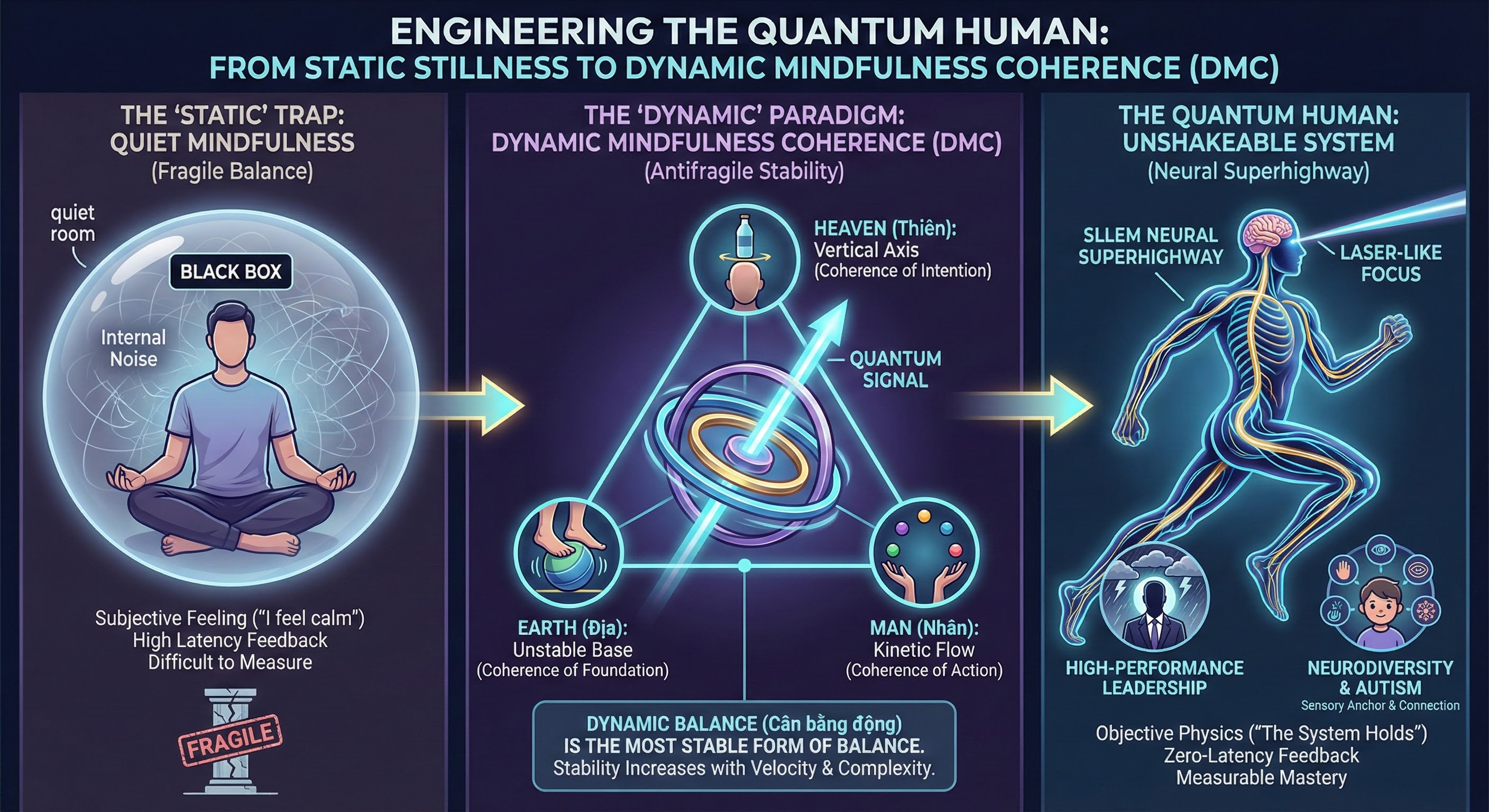
II. Introduction: The Paradox of Stability
Most people define balance as the absence of movement (Static Balance). However, static balance is fragile; it is easily disrupted by external force. In contrast, Dynamic Balance is the most stable and durable form of balance. Consider a gyroscope: when stationary, it falls at the slightest touch. When spinning (in motion), it becomes nearly impossible to knock off-axis. Similarly, the "Quantum Human" does not seek the stillness of a statue, but the Dynamic Coherence of a spinning top. In this state, movement and complexity actually increase stability.
III. Theoretical Framework: Dynamic Mindfulness Coherence (DMC)
DMC is the mastery of maintaining absolute internal stability while executing high-complexity tasks.
-
Static Mindfulness: Difficult to measure, easily broken by noise, often leads to "numbness."
-
Dynamic Mindfulness: Measurable, strengthened by noise, leads to "High-Definition Presence."
The Tam Tài Alignment (The 3 Pillars of Dynamic Balance)
To achieve the most stable balance, the practitioner must align three dimensions simultaneously:
-
Thiên (Heaven): Verticality (The Bottle). Targets the Parietal Lobe. Coherence of Intention.
-
Địa (Earth): Instability (The Medicine Ball). Targets the Fascia/Vestibular system. Coherence of Foundation.
-
Nhân (Man): Kinetic Flow (The Juggling). Targets the Cerebellum/Basal Ganglia. Coherence of Action.
The "Gyroscopic Effect": When Heaven, Earth, and Man are aligned in motion, the human system enters a state of Cân bằng động. It becomes an "Antifragile" system that thrives on chaos.
IV. Clinical Breakthrough: DMC for Autism & Mental Disorders
Dynamic Balance is particularly crucial for individuals with Autism Spectrum Disorder (ASD) and other mental disorders characterized by Signal Fragmentation.
-
The Sensory Anchor: For an autistic child, the world is a storm of noise. Static meditation often provides no "grounding."
-
The Physics-Based Feedback: In QRVEM, the child receives intense, non-negotiable feedback from the medicine ball and the balanced bottle. This Dynamic Loading forces the brain to "reset" and find a stable baseline.
-
Myelinating Connection: Because Dynamic Balance is "the most stable," training it builds the strongest neural superhighways. It bridges the gap between the Prefrontal Cortex and the motor centers, reducing the internal "chatter" and anxiety of the neurodivergent mind.
V. Methodology: SLLEM & The Neural Superhighway
Lifelong Laser-Like Energy Mastery (SLLEM) ensures that Dynamic Coherence moves from a temporary state to a permanent trait.
-
CSPSM (Consistent Sequential Peak Surpassing): Systematically increasing the "Dynamic Load" (e.g., the 7 Differences in juggling).
-
The Myelination Sensor: We measure the "Recovery Latency" ($\Delta t$). The more stable the Dynamic Balance, the thicker the myelin, and the faster the system self-regulates.
VI. Measurement: The "Audit of Physics"
Unlike "Quiet Mindfulness," DMC is Difficult but Measurable.
| Feature |
Static Mindfulness |
Dynamic Mindfulness (DMC) |
| Stability Type |
Fragile Balance (Cân bằng tĩnh). |
Most Stable Balance (Cân bằng động). |
| Validation |
Subjective ("I feel calm"). |
Objective Physics ("The system holds"). |
| Feedback |
High Latency (Delayed). |
Zero-Latency (Immediate Gravity Audit). |
| Neuro-Impact |
Relaxation. |
Neural Superhighway (Myelination). |
VII. Conclusion: The Unified Signal
The engineering of the Quantum Human proves that Dynamic Balance (Cân bằng động) is the ultimate goal of human development. By training through the Tam Tài alignment, we do not just achieve "peace"—we achieve Resilient Coherence.
Whether for an autistic child seeking sensory peace or a CEO seeking clarity under pressure, the path is the same: Embrace movement to find the most durable stillness. Through QRVEM and SLLEM, we transform the human system from a fragmented "receiver" into a coherent, laser-like "transmitter" of energy.